Social Media Has Not Reached Mainstream

You don’t need statistics to tell you that "our world" of social media tools like Twitter, Friendfeed, and RSS has not reached mainstream.
     

Survey Your Surroundings

Just survey your friends or better yet, take a look at who you socialize with the most online. I’m willing to bet my next blog post that at least 60% of the users of the aforementioned services socialize with people that are not necessarily real life friends the most when online. I can guarantee that over 50% don’t have family members or real life friends that use these services, and for those that do, it’s because you probably badgered them into it.


Will Friendfeed, Twitter, and RSS Ever Reach Mainstream?

socialmedia Who knows? I don’t see Friendfeed doing it, but I’ve noticed SocialThing!, a similar service, breaking grounds with the mainstream masses.

Twitter and RSS will reach mainstream, but I don’t see these services being used in the manner that early adopters are using them. Here’s a good example:

I was attempting to explain RSS to a friend. I told her that it’s an easier way to get updates about a site instead of having to visit the site all the time. After I finished explaining how to get the updates, her reply was: "So can I get RSS for Victoria’s Secret?"

Her reply made me laugh. :)
   

Do You Notice The Irony?

My friend wasn’t thinking in terms of blogs or updates about news, because that’s not what she goes online for. Most mainstream internet users don’t go online for these things either. They have the TV, Facebook, and text messaging for that. That’s not to say that our more advanced platforms won’t eventually make it. However, if they do, it will be for an entirely different reason from what made early adopters join these services.
     

Statistics Count For Something

Well, let’s briefly turn to statistics. Marshall Kirkpatrick of Read/Write Web sent me some stats on the traffic between SocialThing! vs Friendfeed using Compete’s site analytics web tool.
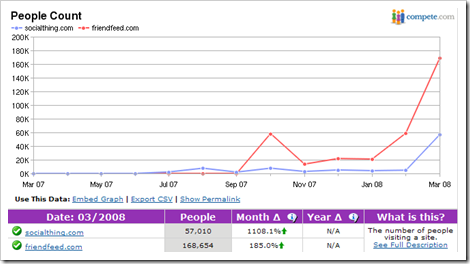
socialthing vs friendfeed
Stats provided by Compete.com 

Now Friendfeed, is definitely more popular, but the tricky part of statistics is you don’t know who the users are. Are more early adopters using Friendfeed or SocialThing!? Are more mainstream web users using SocialThing! or Friendfeed? Do you also notice the spike with SocialThing!’s monthly visitors?
    

I turned to a private forum that a friend of mine started. The forum consists of tech-savvy, yet mainstream web users. They consider me to be the "know it all for the web" on the board. That says a lot in my opinion. I took a look at two threads that were started for Friendfeed users and for SocialThing! users. Currently, there are 3 users (myself included) that use Friendfeed and 9 who are using SocialThing!.

To quote one of the forums users:

Side note: There’s a similar service called FriendFeed (Corvy [Me] uses it a lot so I’m sure she can tell you more about it) that supports a ton more services, however, for me, SocialThing is more intuitive. When you add applications, it knows who your friends are already, whereas with Friendfeed, I believe you have to add others who also have a Friendfeed account. With SocialThing it keeps track of all your friends, regardless of if they are also on Socialthing.

While you can use the "imaginary friend" feature on Friendfeed to follow others, it would be much simpler to use SocialThing! instead of manually setting up "imaginary friends". This would be a conundrum for those who have no clue about RSS feeds.


Advanced Platforms Not Ready For The Masses

Comment2 Maybe the masses aren’t ready for these platforms. Still, these are early adopter tools, regardless of the growth that one may be seeing. They all have the potential to go mainstream, but there’s a lot of work to be done. We’re still in our own bubble. Or are we?


LOVED IT? SHARE IT!:

Twitter Digg Delicious Stumbleupon Technorati Facebook

View Comments to “Social Media Has Not Reached Mainstream”

  1. Great post. I sometimes feel like we've skipped a whole generation of web services. We had all our web 1.0 tools that the mainstream use, understand and are comfortable with (e.g. Ebay). We've since moved onto this second generation of web services that the techies and early adopters swoon over, but just dont make sense to the mainstream (e.g. Twitter, Friendfeed). There is NO demand for those services outside of the tiny minority of early adopers, at least not yet.

    I think there is a market opening for web sevices that can bridge that gap (Web 1.5?). The mainstream don't even use or understand RSS, but us techies have moved on to Twitter and FriendFeed. Why not take a step back and build tools to bring RSS and syndication to the masses first? Otherwise the chasm will just keep growing, and we'll be more and more out of touch with what our friends and family really need.

  2. Great post, Corvida. I was all ready to say, “Wait, my mom and dad are bloggers and use RSS feeds daily!” Then I read:

    I can guarantee that over 50% don’t have family members or real life friends that use these services, and for those that do, it’s because you probably badgered them into it.

    Having gone through the badgering process with them, it's clear to me that the barrier to entry for the 50-60 crowd is less technological and more about perceived value.

    Typing was once a skill one would put on his/her resume. Now, it is a basic requirement to participate online. The same is true for social media and it's corresponding tech, such as RSS feeds. Before my mother knew how awesome it is to socialize with people online, she was resistant to the tech. After she started connecting with people, she quickly learned basic HTML/CSS and stays connected with her friends on Blog Catalog and MyBlogLog. Her tech education was driven by the desire for more and more meaningful connections with other people online. Now she doesn't think about the tech much at all. Mostly we talk about socializing issues, like etiquette.

    I do think intuitive UIs are important for mass adoption. Lower tech barriers might encourage people to explore on more of a whim, which fuels their further interest. I think the biggest reason most of the mainstream isn't here yet has more to do with the belief there is something worthwhile for them to push them through learning the tech. I see the tech skills they need to develop as no more demanding than the skill of typing, which was once done only by trained typing professionals.

  3. I think the web is moving too fast. Social media is great for those who have already embedded themselves, and their identify on the web. Social media provides tremendous value for such people. For most people, however, they are just getting through the email, Yahoo groups and forums (web 1.0) world.

    Social Media will need to evolve in a way that provides value in peoples everyday life. It will need to be easily integrated into their lives, making the things they do easier.

    It will be interested in watching.

  4. I don't really agree with you on that. Face Book, MySpace, Linked In have already been used by Large Corporations when they advertise for jobs or looking at recruiting people. However, I must agree that corporations are not catching on FriendFeed or Twitter.

  5. I don't really agree with you on that. Face Book, MySpace, Linked In have already been used by Large Corporations when they advertise for jobs or looking at recruiting people. However, I must agree that corporations are not catching onto FriendFeed or Twitter.

  6. I don't really agree with you on that. Face Book, MySpace, Linked In have already been used by Large Corporations when they advertise for jobs or looking at recruiting people. However, I must agree that corporations are not catching onto FriendFeed or Twitter.

blog comments powered by Disqus